
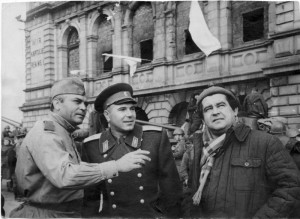

Yuli Anshelevich
Yuli Anshelevich (23rd of January 1931, Riga, Republic of Latvia – 22nd of August 2004, Riga, Republic of Latvia) – a clinical doctor, Hab. doctor of medicine, a professor, an academician of the Latvian Academy of Sciences.
Yuli Anshelevich was born into the family of physician Vulf (1894–1968) and Elena (1896–1968). His father studied medicine in Heidelberg and St. Petersburg, received his medical degree in Tartu, and, in order to obtain the right to practice in Latvia under the regulations at the time, passed exams at the Faculty of Medicine of the University of Latvia in 1925. He had worked in the town of Rēzekne until 1941. The family had two sons, Cemakh and Yuli (both of whom became doctors); the spoken language at home was Russian, but everyone was also fluent in Latvian and German.
During World War II, the family was evacuated, and upon returning to Latvia in 1945, they settled in Riga. Yuli Anshelevich, skipping grades, graduated with honors from Riga’s 18th Secondary School in 1947 and, like his brother before him, enrolled in the Faculty of Medicine of the Latvian State University (from 1950 – Riga Medical Institute), which he completed with honors in 1953. Admission to the institute was not easy: he passed all six entrance exams excellently, but at that time he was not yet 17, which did not meet the requirements for applicants. The admissions committee initially rejected him, but due to the intervention and personal guarantee of the Minister of Health, Adolfs Krauss, he was admitted.
After working for a year at Jelgava City Hospital, he entered postgraduate studies, and from 1954 Anshelevich devoted his professional life to his alma mater – Riga Medical Institute: postgraduate student (1954–1956), assistant at the Department of Internal Diseases (1956–1959) and the Department of Hospital Therapy (1959–1962), associate professor (1962–1966), head of the Department of Therapy (1967–1999), professor (1968–1999), and head of the Clinic of Internal Diseases at the 1st Riga City Hospital.
He earned the degree of Candidate of Medical Sciences (1958) and Doctor of Medical Sciences (1967).
He was honored as a Distinguished Physician of the Latvian SSR (1975) and a Distinguished Scientist (1981), a corresponding member (1989) and full member (1992) of the Latvian Academy of Sciences.
Yuli Anshelevich dedicated his life to medicine, specializing in cardiology and addressing problems of cardiovascular pathology and other internal diseases. He formulated the concept of the pathogenetic commonality of various forms of coronary insufficiency, developed methods for urgent diagnosis and therapy for population health monitoring, as well as contributed to the creation of several devices for heart research based on new principles.
He authored over 350 publications, 10 monographs, more than 100 popular science articles, and held 2 patents. The 1984 monograph he co-authored, Praktiskā kardioloģija (“Practical Cardiology”), has been republished and remains a standard reference for Latvian cardiologists. Under his guidance, 15 dissertations were prepared and defended. He participated in testing and implementing 10 new medications and delivered 1,200 lectures.
Yuli Anshelevich was an Honorary Member of the European Society of Cardiology, the Latvian Medical Association, and the New York Academy of Sciences. He was the founder and long-time chairman (1972–2000) and later honorary president of the Latvian Society of Cardiologists, as well as chairman of the Senate of Riga Stradiņš University (2002–2004).
He received the State Prize of the Latvian SSR (1977), a commemorative medal in honor of David Jeronim Grindel (1999) for contributions to cardiology, honorary diplomas from the International Cambridge Biographical Association for outstanding achievements in medicine, and the Order of the Red Banner of Labor (1981).
Anshelevich was an initiator and active participant in the 1993 restoration of Bikur Holim Hospital, originally established in Riga in 1924, serving as chairman of the hospital board (1997–2004). In 1970, he initiated the creation of the “Golden Stethoscope” competition for 4th–6th-year medical students in Latvia to identify talented young people capable of demonstrating broad knowledge in internal medicine, and remained its constant director. Since 2007, the competition has borne his name, and in 2014 it was held for the 44th time. In an interview, when asked if he was happy, Anshelevich replied, “Partially, because a whole life cannot consist only of happiness,” and when asked how he ranked the importance of his work, he said, “First comes treating patients, second teaching students, and only then scientific work.”
Y. Anshelevich passed away on August 22, 2004, after a serious illness, and was buried next to his parents in the Šmerlis cemetery.
His two sons, Mikhail and Valentin, followed in the footsteps of their father and grandfather and became doctors.
In 2005, at the initiative of Riga Stradiņš University, a memoir was published: Jūlijs Anshelevičs. Cilvēkiem veltīts mūžs (“Yuli Anshelevich: A Life Dedicated to People”). The book aims to commemorate an outstanding person and physician, compiling memories from his students, colleagues, friends, and family living in Latvia, the USA, Russia, Germany, Norway, and Israel.
Erika Tyunina
From A.F. Blüger’s book Time: For and Against (Riga, 2006, pp. 156–158):
“Yuli was greatly loved by the students of our medical institute. There was never an empty seat in his lecture halls. He was a lecturer of the highest caliber. His students not only passed exams successfully using his lecture notes, but often referred back to them even as practicing physicians. The recognition and affection future doctors felt for their favorite professor is evidenced by the fact that for 18 consecutive years, students of Riga Medical Institute unanimously chose him to deliver the valedictory speech from the teaching staff at the graduation ceremony. Perhaps this is a unique case in the history of our medical university… Yulik was a very principled and exceptionally honorable man… He was reserved in expressing emotions and never patted anyone on the shoulder; he always maintained a professional distance. In the hospital and at the department, everyone respected him, though they also slightly feared him. He could be strict and demanding during clinical rounds, never forgiving inattentive treatment of patients… Yulik played the violin remarkably well. He had perfect pitch and an excellent violin education; one of his teachers was the renowned professor Karl Brückner.”
Sources of information:
„Jūlijs Anšelevičs. Cilvēkiem veltīts mūžs”. Atmiņu grāmata. – Rīga: Rīgas Stradiņa universitāte, 2005, 224 lpp.;
А.Ф. Блюгер «Время: за и против». – Рига, 2006, 248 с.
100 nozīmīgas personas Latvijas medicīnas vēsturē. http://www.ieverojamiemediki.lv/a/julijs-anselevics/
Related illustrations