
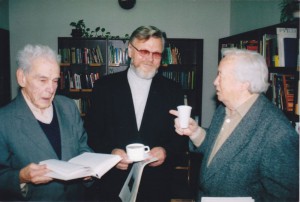

Olga Bobrova
Olga Bobrova (born Antipova; 6th of April 1939, Kharkiv, Ukrainian SSR) – a soprano soloist of the orchestras "Slavyane" and "Sadko", ensembles "Nostalgia" and "Variant".
Her father, Ivan Antipov, came from a family of military servicemen, while her mother, Tatyana Romensky, was from a clerical family. After the end of the war, in 1946, the family moved to Riga to join relatives, where Olga graduated from Secondary School No. 18 and began working in the experimental workshop of the VEF factory.
In 1956, she started attending the vocal studio at the VEF Palace of Culture. In 1967, she graduated from the Riga Polytechnic Institute and continued working at VEF as an engineer. That same year, she resumed her vocal training at the VEF Palace of Culture studio under the outstanding teacher, Honored Artist of the Latvian SSR Evgenia Tomgorova, and also worked with excellent accompanists L. Sverdlova and I. Bocharnikov.
“I am immensely grateful to Evgenia for her warmth, vitality, and highest professionalism—it was she who revealed to me the full beauty of vocal music. And Igor Bocharnikov worked with exquisite precision on performance and interpretation; we became close friends, and our creative partnership lasted for many years,” the singer recalls.
In 1968, Olga married Kirill Bobrov. She studied at the People’s Conservatory of the Latvian State Conservatory named after Jāzeps Vītols. In 1969, she enrolled in the Jāzeps Mediņš Music College as a vocal student, but had to discontinue her studies a year later due to the birth of her child. In 1982, Olga Bobrova became a soloist with the “Sadko” orchestra at the VEF Palace of Culture.
Olga Bobrova is a laureate and prize-winner of numerous amateur art competitions. She performed in concerts at the “Ave Sol” hall and was a frequent participant in the themed evenings “From Heart to Heart” at the Museum of Foreign Art, organized and conducted by Igor Bocharnikov together with the museum’s art historian Vera Bartashevsky. The themes of these evenings were very diverse—ranging from classical music and old romances to programs dedicated to Alexander Pushkin, Mikhail Lermontov, and others.
In these concerts participated soloists of the Latvian National Opera Eduard Chudakov, Roman Polisadov, Galina Polyakova and Larisa Lyutko (the “Classic Duo”), L. Baykov, V. Bul, actress of the Riga Russian Theatre Nina Neznamova, young musicians and students of the Latvian Conservatory, and the “Slavyane” orchestra conducted by Viktor Zhilyaev.
After the death of I. Bocharnikov, Valery Bul organized the vocal ensemble “Nostalgia” under the Riga City Council, in which Olga Bobrova was also a soloist, with the virtuoso Yuri Kasper as accompanist. For many years, Olga was also a soloist of the Russian folk instruments ensemble “Variant.” She participated in concerts at the Russian House organized by Y. Pavlova, as well as in author concerts at the Latvian Society of Jewish Culture organized by writer and songwriter A. Zaslavsky.
From 1991 to 1993, Olga Bobrova had been a choir singer at the Holy Trinity Cathedral.
The singer’s repertoire was extremely broad—from folk songs and old romances to classical vocal works. Possessing a beautiful lyrical timbre, vocal brilliance, and mastery of nuance, she could not fail to touch the hearts of listeners; her performances were always eagerly anticipated and warmly received.
When asked about her creative motto, the singer replied: “I would like to remain in your hearts forever as a song.”
Galina Polyakova
Related illustrations