

Olga Benois
Olga Benois (6th of October 1914, Petrograd, Russian Empire – 16th of July 1994, Riga, Republic of Latvia) – the head of the orphanage for children from Salaspils labour camp at Riga seaside in 1943-1944.
O. Benois was born in Petrograd (St. Petersburg). Her father, Elisei (before his conversion to Orthodoxy – Eduard) Benois (1890–1914), was a student of the Faculty of Technology at the Imperial St. Petersburg University and a descendant of a well-known family of architects and artists in Russia. His father, Yulii Benois (1852–1929), was a prominent architect in St. Petersburg. Her mother, Olga Benois (née Waldmann, 1891–1980), was half German, Orthodox, and a native of St. Petersburg. Olga and Elisei Benois had three children: a son, Elisei (1913–1932), who studied at the Russian cadet school in Serbia, where he caught a cold and died. On October 6, 1914, twin daughters were born: Lidia (1914–2008, USA) and Olga (1914–1994, Riga, Latvia). Their family happiness was short-lived. At the beginning of the First World War, Elisei joined the army, and was later killed in action in October 1914.
The childhood of O. Benois was spent in Finland, at her father’s estate, and later in Viipuri (Vyborg). In 1930, the Benois family decided to move to Latvia, to Riga, where mother's friend, the harpist of the National Opera, Clementina Khibshova, was living. The reasons for the move were the mother’s desire to provide her daughters with an education in Russian (which was difficult in Finland), as well as financial considerations, namely the assistance provided by K.Khibshova.
In Riga, the sisters Olga and Lidia Benois initially enrolled in the gymnasium of L. Tailova, but after its closure, they continued their education at the Riga Private Russian Practical Gymnasium, from which they graduated in 1934.
Together with her sister and mother, Olga Benois was a member of the Russian Orthodox Student Association (until its closure by the authorities in 1934).
In 1935, at the mother's insistence, Lidia and Olga went to England to study English. In the late 1930s, Olga came to visit her mother, as she thought temporarily. However, the outbreak of the Second World War separated the two sisters for a long time. Lidia completed nursing courses, married in 1945, and moved to the United States.
Olga and her daughter lived in Latvia with Nansen passports, that is, they were considered stateless persons. They retained this status in 1940–41 as well.
For one year, O. Benois studied in the studio of Professor J. Tilbergs.
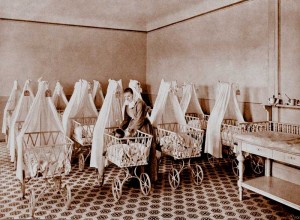
In 1940, Olga Benois entered the Latvian Academy of Arts, where she attended classes in the figurative workshop (headed by L. Liberts). In November 1943, she interrupted her studies at the Academy in order to help children from the Salaspils labor camp who had been transferred to a shelter on the Riga seashore. The children were in extremely poor condition—ill, psychologically traumatized, and often orphaned. The shelter was initially located in Dubulti, and later in Bulduri (5 Sadovaya Street). At first, it was funded by donations, and later it came under the authority of the Social Department, which allocated only minimal funds that did not cover even the most basic expenses. The shelter housed children aged from 1 to 15 years. The number of children ranged from 70 to 230. According to O. Benois, during her time there, 480 children passed through the shelter. She went to work there because she loved children very much and sincerely wanted to help them.
After the capture of Riga and the Riga seashore by units of the Red Army, the shelter was dissolved, and the children came under state care. However, severe trials awaited Olga, as they had her mother. On March 6, 1945, a warrant for her arrest was signed.
“The case of O. Benois” was handled by the Counterintelligence Department SMERSH of the 2nd Baltic Front. On April 16, 1945, an indictment was issued, according to which she was accused of abusive treatment of Soviet children, of maintaining harsh living conditions, poor nutrition, and unsanitary conditions that led to exhaustion and the spread of infectious diseases, as well as of sending children to work in Germany and to local kulak elements.
Although at the session of the Military Tribunal the individuals (former shelter employees) who had previously testified against her did not confirm the facts of abuse, the verdict of the NKVD Military Tribunal troops of April 30, 1945, was nevertheless severe: 10 years in corrective labor camps with subsequent deprivation of rights for a period of 2 years.
Olga Benois courageously endured the severe ordeal that befell her. She was released from imprisonment, which she had served in Camp Division No. 22 in Norilsk, on October 11, 1954. However, she was not allowed to return home and was instead sent into special settlement. The struggle for her right to return home and to have the charges against her lifted was led primarily by herself, who submitted a petition to the Prosecutor General of the USSR. Clementina Khibshova also interceded on her behalf. At last, justice prevailed. On August 7, 1956, the sentence against O. Benois was annulled, and the case was closed.
O. Benois was able to return to Riga and embrace her mother, who had also endured severe trials. Life had to be started anew. Continuing her studies at the Academy of Arts was no longer possible. Olga never married and had no children. However, while in the camp, she befriended a very young Siberian woman, Nina Egorova. After their release, they remained in contact. Olga invited Nina to move to Riga, which she did. Nina had dreamed of entering the Academy of Arts, but after settling in the apartment of the well-known physician Vladimir Kosinsky, she decided under his influence to become a doctor. N. Egorova married, graduated from the Riga Medical Institute, and did not forget the Benois family, helping both ladies in difficult times. The Benois family and Nina lived in great harmony, like sisters.
Olga, like her mother, was a parishioner of the Nativity of Christ Cathedral (until its closure by the authorities in 1961) and the Church of St. Alexander Nevsky.
Olga Benois died on July 16, 1994.
Photoalbum «Riga branch of Benois family»
Text prepared by Tatiana Feigmane, Anna Done and Vera Bartoschevsky
Sources of information:
ЛГА, ф. 1986, оп. 2, Р-2098.
ЛГА, ф. 485, оп. 1, д.71.
Юлия Александрова. Рижские потомки Бенуа
Т. Амосова. Вера - источник жизни семьи Бенуа
Т. Амовова. Две Ольги. Две судьбы
Рацевич С.В. Из виденного и пережитого
Репрессированные деятели культуры и искусства в истории Красноярского края