

Mikhail Bolshesolsky
Mikhail Bolshesolsky (5th of January 1891, Saratov Governorate, Russian Empire – 29th of May 1943, Vyatlag, Kirov Oblast, Russian SFSR) – a teacher of mathematics, physics and cosmography.
Mikhail Bolshesolsky was born in the town of Kamyshin (now in the Volgograd Region of the Russian Federation) into the family of a railway worker.
He received his primary education in Arkhangelsk, after which he entered the local gymnasium. Following his father’s death, however, he transferred to the Kostroma Gymnasium, which he graduated from in 1909. In the same year, he enrolled in the Faculty of Physics and Mathematics of the St. Petersburg Imperial University, from which he graduated in 1914.
With the outbreak of the First World War, he was conscripted into the army and entered the Pavel Military School, which he completed on an accelerated course on February 1, 1915. He was assigned to the 31st Siberian Regiment (according to other sources, the 15th Siberian Regiment). In 1915–1916, he served in Krasnoyarsk, from where he was sent to the Petrograd Officers’ Electrotechnical School. After graduating, he was assigned to the Caucasian Front, where he served until 1917. In the Imperial Army, he rose to the rank of second lieutenant.
In 1918–1919, he served for some time in the Red Army as head of the Northern radio-telegraph network. During this period, he married Baroness Ekaterina (née Rosenschild-Paulin), a native of Latvia. Apparently, this circumstance prompted him to desert the Red Army and flee to Latvia. In 1921, he was detained by Latvian authorities on suspicion of sympathizing with Bolshevism and spent two months in Riga Central Prison.
Initially, Bolshesolsky gave private lessons. From January 1, 1923, he worked as a mathematics teacher at A. Tilte’s Russian primary school in Tukums. In the 1924/25 academic year, he taught at the Ludza State Secondary School (Latvian-language). At the same time, he taught at the Ludza Municipal Jewish Secondary School. In 1932, through a competitive process, he was appointed teacher of mathematics, physics, and cosmography at the Ludza Russian State Gymnasium.
The Russian Department of the Ministry of Education authorized Bolshesolsky to teach physics at the Rezekne Russian Pedagogical Institute.
In 1935, following the closure of the Ludza Russian State Gymnasium and the Rezekne Russian Pedagogical Institute, Mikhail Bolshesolsky lost his job.
After the Soviet occupation of Latvia, he returned to teaching.
On September 24, 1940, by decision of the People’s Commissar of Education, Pēteris Valeskalns, Bolshesolsky was appointed acting director of the Rezekne Russian Gymnasium; however, already on January 30, 1941, he was dismissed from this position.
On June 14, 1941, M. Bolshesolsky was deported from Latvia. He was accused of deserting the Red Army during the Civil War and illegally crossing the Latvian border. In addition, in 1940 he allegedly obstructed the activities of the school Komsomol organization. By a decision of the Special Council of the NKVD of the USSR on December 2, 1942, he was sentenced to 10 years in corrective labor camps (the indictment had proposed execution).
Mikhail Bolshesolsky died in Vyatlag on May 29, 1943.
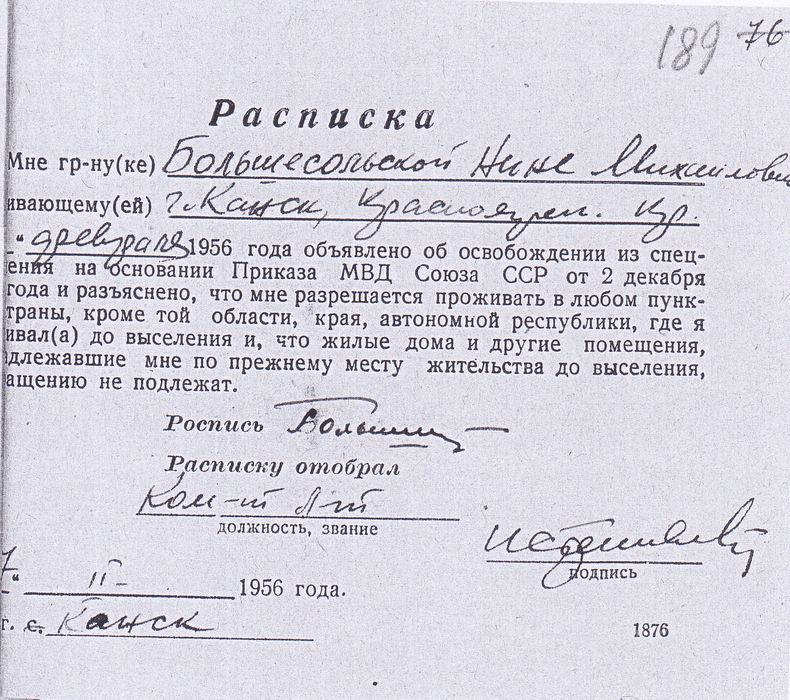
On the same day, June 14, 1941, the entire Bolshesolsky family was deported. The eldest son, Vsevolod, was deported separately and sentenced to 10 years in labor camps. He was accused of membership in the “Sokol” society and of connections with the NTSNP (National Labour Alliance of the New Generation). After serving his sentence, he reunited with the family, who were living in exile in the settlement of Ust-Port in the Krasnoyarsk Territory. During exile, Elena and Tatyana died in 1943, and Pavel died a year later. In 1956, the Bolshesolsky family was informed of their release from special settlement, but they were forbidden to return to Latvia. In the same year, Ekaterina Bolshesolsky died.
Family
Wife – Ekaterina (née Rosenschild-Paulin) (1891–1956).
Children: Vsevolod (1921–?), Pavel (1922–1944), Elena (1923–1943), Tatyana (1925–1943), Igor (1926–?) and Nina (1927–?).
As of 1990, only the youngest daughter, Nina, remained alive, residing in the town of Kansk.
Tatiana Feigmane
Sources of information:
ЛГИА, ф. 1632, оп. 1, д. 2704.
ЛГА, ф. 1986, оп. 2 , д. П-5634.
ЛГА, ф. 1986, оп. 2, д. П-7216.
ЛГА, ф. 1987, Резекне, д. 15424; ЛГА, ф. 1986, оп.2, д. П-7216.
Related illustrations