
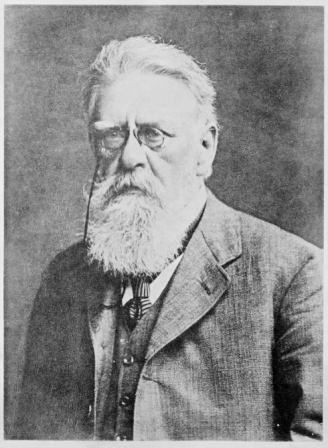
Leonid Arbuzov
Leonid Arbusow (7th/19th of January 1848, Mitau/Jelgava, Courland Governorate, Russian Empire – 1st/14th of January 1912, Riga, Russian Empire) – a historian.
The future Baltic German historian Leonid Arbusow was born in Mitau (now Jelgava) into the family of an officer of the Russian Imperial Army. His father, Alexander Arbusow, was a nobleman from an ancient lineage, two representatives of which had held the office of voivode as early as the 17th century. Alexander Arbusow owned estates in the Novgorod and Pskov governorates. The future historian’s mother, Natalia, came from the Novgorod family of Orthodox priests known as the Chudovskys; her great-grandfather had also been a priest.
The fate of Leonid Arbusow’s parents was tragic. His mother died of cholera in Mitau just a few months after his birth, and his father passed away when Leonid was seven years old. He was raised by the family of Natalia Chudovsky’s friend, Feodosia Pauker. The head of that household, the Baltic German Magnus von Pauker, was a renowned mathematician and a corresponding member of the St. Petersburg Academy of Sciences. After his death, Leonid’s upbringing was taken over by his son, Karl Pauker, a professor of Ancient Greek language and literature.
In this family, Leonid received an upbringing in the German cultural tradition. He studied at a private school in Mitau. For a long time, he was unable to decide on a profession: he studied zoology at Dorpat University (now the University of Tartu), medicine at Leipzig University, spent three years studying the natural sciences at Göttingen University, and then another three years studying history under the guidance of the renowned German historian Georg Waitz. Altogether, Leonid studied at universities for nearly ten years.
From 1877 to 1885, L. Arbusow had been working as a teacher of natural science at the district school in Bauska; from 1885 to 1888, he had been serving as an inspector of district schools in Tuckum (now Tukums), and later worked as a private tutor in Mitau.
However, Leonid Arbusow became widely known as a historian. He was the first in Latvia to compile an extensive database of individuals from medieval Livonia—more than one thousand knights and five thousand clergymen.
In 1889, Arbusow’s fundamental work “An Outline of the History of Livonia, Estonia, and Courland” was published in German. It was one of the earliest comprehensive studies of the history of the Baltic region. Paradoxically, this work—written in German by the son of a Russian officer—was published in Russian only in 1912, shortly after the scholar’s death.
Leonid Arbusow’s major work was written from positions shared at the time by a portion of the Baltic German community. It emphasized the progressive significance of the arrival of the crusaders in the Baltic lands and argued that in the Middle Ages “cruel” landlords were the exception rather than the rule. The book says almost nothing about Latvians or other peoples living in Livonia and Courland.
In 1893, Leonid Arbusow moved to Riga, where he lived until his death. In 1894, he became co-chairman of the Society for the History and Antiquities of the Baltic Provinces. He published a number of books on the history of Livonia in German.
Leonid Arbusow died on January 1 (14, New Style), 1912, and was buried at the Zasulauks Cemetery in Riga.
Family
In 1884, while living in Bauska, L. Arbusow married Olga Anschütz. Their son, Leonid-Hans-Nikolai Arbusow, became a professor at the University of Latvia in independent Latvia. In 1939, L. Arbusow moved to Germany, and after the Second World War he worked as a part-time lecturer at Göttingen University.
Alexander Gurin