
George Browne
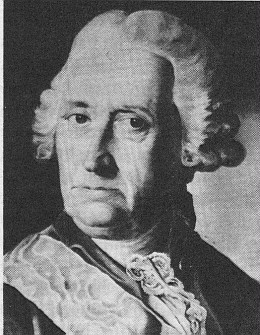
Yury Browne (George Browne; 25th of June 1698, Limerick, Ireland – 18th/29th of September 1792, Riga, Russian Empire) – count, the Governor-General of Riga from 1762, from 1882 to 1792 the Governor-General of the Baltic provinces.
George Browne, the future general and Governor-General of Riga, was born in the County of Limerick, Ireland. He belonged to an ancient family which, according to tradition, had come to Britain in the eleventh century with William the Conqueror. As a Roman Catholic, Browne had little prospect of advancing his career in the dominions of the British Crown. Consequently, while still a young man, he entered foreign service. He first served under the Elector Palatine in Germany and, in 1730, entered Russian service, remaining in the Russian Empire for more than sixty years.
During his military career in Russia, Yury Browne (as he was known in Russia) took part in numerous campaigns and distinguished himself by his courage and military skill. In 1733–1734 he had been participating in the Russian campaign in Poland under the command of his fellow Irishman Peter Lacy, the celebrated field marshal and Governor-General of Livonia—a post that Browne himself would later hold.
Browne also served in the Russo-Turkish War of 1735–1739. Captured by the enemy, he managed to escape, bringing back valuable intelligence. In recognition of this feat, he was promoted to the rank of Major General. During the war against Sweden in 1742, he commanded the troops defending the territory between Narva and St Petersburg. His successful command earned him promotion to Lieutenant General.
He fought in a number of major engagements during the Seven Years' War (1756–1763) and, during the conflict, was promoted to the rank of General-in-Chief. Browne won particular renown at the Battle of Zorndorf, where he received eleven wounds yet refused to leave the battlefield. After the battle, Empress Elizabeth granted him an indefinite leave of absence to recover his health while allowing him to retain his full salary—an exceptional privilege for that period.
In 1762, the ageing general, for whom active military service had become increasingly difficult, was appointed Governor-General of Riga, a position he held for the next thirty years.
During his tenure as Governor-General, Browne achieved a great deal. Among his most significant accomplishments was the regulation of peasants' obligations toward their landlords. In 1765 he issued a decree requiring all landed estates to submit declarations detailing the obligations imposed upon their peasants as they had existed at the time of the previous Landtag (assembly of the nobility). Any subsequent increase in those obligations obliged the landlord to compensate the peasants financially.
The sale of serfs outside the province was prohibited, as was their sale at public auction. Husbands could no longer be sold separately from their wives, nor wives separately from their husbands. Landowners were forbidden to restrict the right of peasants to marry. District physicians were required to provide medical treatment for sick serfs. A number of other measures were likewise introduced, modestly improving the condition of the peasantry.
During Browne's administration, Riga saw extensive urban development. The Citadel, the Orthodox Cathedral of Saints Peter and Paul, the stone Jacob's Barracks, and the Russian Gostiny Dvor (merchant arcade) were constructed. It was also under his administration that the manufacture of the famous Riga Black Balsam began on a manufactory basis, alongside the establishment of several other manufactories. Large warehouses for storing hemp were built along the Daugava (Western Dvina); several later hemp warehouses still survive today as part of the Riga Central Market complex.
At Browne's initiative, the dilapidated houses standing in front of Riga Castle were demolished—their owners receiving substantial financial compensation—and Palace Square was laid out in their place. In 1773, following the prohibition of burials within the city limits, the Great Cemetery, St James' Cemetery, and Pokrov Cemetery were established beyond the suburbs of Riga.
During Browne's governorship, Riga's first district school with Russian as the language of instruction was founded in 1789. It was later renamed the Catherine School.
In 1765, a new statute governing Riga's commerce was enacted, granting somewhat broader commercial rights to Russian and Latvian merchants within the city.
In 1783, the Governorate of Livonia was reorganized into the Riga Viceroyalty. This reform involved much more than a simple change of name. Within a few years, Riga's previously permanent magistracy was replaced by an elected city council, while Empress Catherine II (the Great) abolished the distinction between burghers and non-burghers. All townspeople, regardless of ethnicity, who had reached the age of twenty-five and met the required property qualifications, became eligible to vote in municipal elections.
Governor-General Browne's achievements received high recognition both within Russia and abroad. In 1774, the Holy Roman Emperor conferred upon him the hereditary title of Count.
Count Browne lived to the age of ninety-four, retaining full clarity of mind until the end of his life. A week before his death, sensing that his end was near, he wrote a letter to Empress Catherine. He did not write about himself; instead, he warmly commended his secretary and assistants and asked the Empress to advance their careers. Catherine later remarked:
"I always held Count Browne in the highest esteem and keenly feel how great a loss his death has been."
Yury Browne died in Riga on 18 September (29 September, New Style) 1792.
Browne was first married to Helen Lacy, daughter of the Irish-born Russian Field Marshal Peter Lacy. After her death he married Eleonore Christine von Mengden, a Baltic German noblewoman. His son, Ivan Browne, served as commander of the Kexholm Infantry Regiment.