
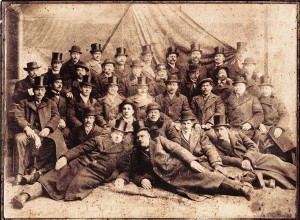

Olga Benois
Olga Benois (28th of June 1891, St. Petersburg, Russian Empire – 1st of November 1980, Riga, Latvian SSR) – a co-Chairperson of Ladies' Committee of Riga Orthodox Cathedral of the Nativity of Christ in 1943-1944.
Olga Benois was born in St. Petersburg into the family of Friedrich Waldmann, an ethnic German who worked as an accountant for a company supplying machinery from England to Russia’s flax-spinning industry. Her mother, Lidia (née Ilyina), was Russian and a native of St. Petersburg. In 1900, Olga Benois (Waldmann) enrolled in a girls’ gymnasium on Vasilyevsky Island, from which she graduated in 1910. That same year, she traveled to Northern England, where she had been attending English language improvement courses for two and a half months. After returning to her homeland, she married Elisei (before his conversion to Orthodoxy – Eduard) Benois (1890–1914), a student of the Faculty of Technology at St. Petersburg University, who came from the renowned Benois family of artists and architects in Russia. His father, Yulii Benois (1852–1929), was a widely known architect and a cousin of the famous Russian artist and founder of the “World of Art” movement, Alexander Benois (1870–1960).
Olga and Elisei Benois had three children. Their son, Elisei (1913–1932), studied at the Russian cadet school in Serbia but caught a cold there and died. A year after the birth of their son (on October 6, 1914), twin daughters were born: Lidia (1914–2008, USA) and Olga (1914–1994, Riga, Latvia). Their family happiness was short-lived. At the beginning of the First World War, Elisei started his military service and was later killed in action.
Left with three small children, Olga went to Finland, where her husband had an estate near Vyborg, which he inherited from his childless godfather. In 1917, she returned to Petrograd (St. Petersburg), which was engulfed in revolutionary unrest, to her ailing father, who lived at No. 24 Bolshoy Prospekt on Vasilyevsky Island. In 1922, after her father’s death, she left for Finland with her children with official permission from the Soviet government, where she sold the estate and purchased a one-story house with a basement in Viipuri (Vyborg).
In 1930, O. Benois, together with her daughters, settled in Latvia, where her longtime acquaintance from St. Petersburg, Clementina Khibshova, was living and working as a harpist at the National Opera. Among the reasons for moving to Latvia were the desire to provide the girls with an education in Russian, as well as financial considerations. In Latvia, O. Benois became involved in local public life. In the early 1930s, she was a member of the Russian Student Orthodox Association (until its closure in 1934).
In 1935, at the insistence of their mother, Lidia and Olga went to England to study English. In the late 1930s, Olga came to visit her mother, but the outbreak of the Second World War prevented her from returning to England. Thus, the life paths of the two sisters diverged.
Both Benois and her daughter Olga lived in Latvia with Nansen passports, that is, they were considered stateless persons. They retained this status in 1940–41 as well.
In 1940, daughter Olga entered the Latvian Academy of Arts. However, in 1943 she interrupted her studies to help children from the Salaspils camp who had been transferred to a shelter on the Riga seashore.
At the same time, Olga Benois, at the suggestion of the dean of the Riga Cathedral of the Nativity of Christ, Father Ioann Janson, agreed to become one of the co-chairs of the Ladies’ Committee attached to the Cathedral. The aim of the Committee was to provide material assistance to Russian refugees (people who had been forced or had voluntarily ended up in Latvia) and to local Russians in need. The funds for this assistance were raised through donations.
As early as November 1944, that is, one month after the capture of Riga by units of the Red Army, Olga began to be summoned for interrogations by the NKVD. On January 9, 1945, a warrant for her arrest was signed. However, the investigation into her case in Riga was not completed. O. Benois was transferred to the Molotov Region of the RSFSR, where on March 11, 1946, an indictment was drawn up, according to which she was charged with anti-Soviet agitation, participation in the Ladies’ Committee, and assistance to Latvian legionnaires. On June 20, 1946, the Special Council of the NKVD of the USSR sentenced her to five years in a corrective labor camp.
Olga endured this severe trial with courage. In the early 1950s, she returned to Riga and lived a long life, remaining a devoted parishioner of the Nativity of Christ Cathedral (until its closure by the authorities in 1961) and the Church of St. Alexander Nevsky. Until her death, her apartment at 34 Skolas Street, and from 1976 in Imanta (a district of Riga), was a center of spiritual life for the Russian community, the Russian intelligentsia, and Orthodox clergy. There was not a single day when someone did not come to her for advice or spiritual support. She maintained correspondence with metropolitans, bishops, and priests. Especially many guests gathered on Christmas and Easter, name days, and birthdays.
Olga Benois died on November 1, 1980, and was buried at Ivanovskoe Cemetery in Riga.
Photoalbom «Riga branch of Benua family»
Tatiana Feigmane, Anna Done, Vera Bartoschevsky
Sources of information:
ЛГА, ф. 1986, оп.2, д. П-6503-Л
Т. Амосова. Вера – источник жизни семьи Бенуа