
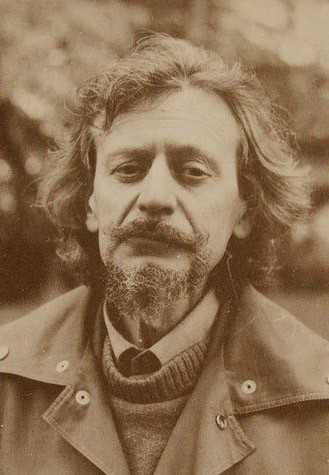
Mikhail Bodrov
Mikhail Bodrov (3rd of February 1937, Rezekne District, Republic of Latvia – 15th of August 1997, Rezekne Municipality, Republic of Latvia) – a scholar, a linguist, a poet, a Latgalian public figure.
M. Bodrov was born in the village of Bodrovka in the Ruzhina (now Silmala) parish of Rēzekne district, into a peasant Old Believer family. He graduated from a seven-year school in the village of Malta, an evening secondary school in Sloka (Riga seaside), and the Faculty of Philology of the Daugavpils Pedagogical Institute (1962).
After graduating from the institute, he worked as a teacher at the Tiskādi boarding school and Ilūkste Secondary School No. 2.
From 1968 to 1982, he had been teaching at the Biysk Pedagogical Institute at the Department of Russian and Foreign Literature. After completing postgraduate studies at the Moscow Regional Pedagogical Institute, he defended his Candidate of Sciences dissertation in 1976 on the poetry of V. Mayakovsky.
In 1982–1988, M. Bodrov had been a senior lecturer, and in 1988–1994 an associate professor at the Department of Russian and Foreign Literature of the Daugavpils Pedagogical Institute. He was a brilliant literary scholar and teacher. He did much to restore the name and work of Leonid Dobychin from oblivion.
M. Bodrov said that in Latgale he had two “nests,” two “roots” — his native Bodrovka, where he spent his childhood, attended school, where the village cemetery and his fellow villagers were; and Daugavpils — where he was a student of the pedagogical institute, where he started his family, and where he established himself as a scholar-philologist, a recognized expert on 20th-century Russian poetry.
Due to illness, he was forced to leave teaching at the institute. He spent his final years in his native village, engaged in literary work. In 1994, he published a collection of poems At the Crossroads: Diary Rhymes, prepared a second for publication, and published poems in periodicals and in the collection Days of Poetry.
M. Bodrov believed that, having once left his village and become a scholar, he remained in an unpayable debt to his native village, and that he was obliged to repay this moral debt. He was driven by the idea of the spiritual and moral revival of Latgale; he dreamed of opening a Sunday spiritual and educational school and a museum of Old Believer life in his homeland. Often, carrying a stack of books and a backpack filled with them, he would go to neighboring villages, proudly calling himself a “book carrier.”
According to the recollections of A. Grodzitsky, being a seriously ill man, Bodrov single-handedly cultivated his mother’s field, clearing it of heavy stones, and built a house. He dreamed that people who had lost their connection with their native land but came annually to commemorate their ancestors would gather there. He dreamed that they would see the garden, rest in the shade of the trees, and eat an apple. And he manually cultivated the beds, planted trees and shrubs, and dug a deep pond… In his thoughts and actions, he was an honest and selfless man, but, as noted by E. Nikitin, a correspondent of the newspaper Rezeknenskie Vesti, he was often far removed from the realities of everyday life.
In 1998, the first scholarly conference, named the “Bodrov Readings,” took place. This academic symposium was devoted to the history, traditions, and culture of Russian Old Believers in Latvia. Scholars, politicians, public and religious figures from Latvia, Lithuania, Estonia, Poland, Belarus, Russia, and the USA took part.
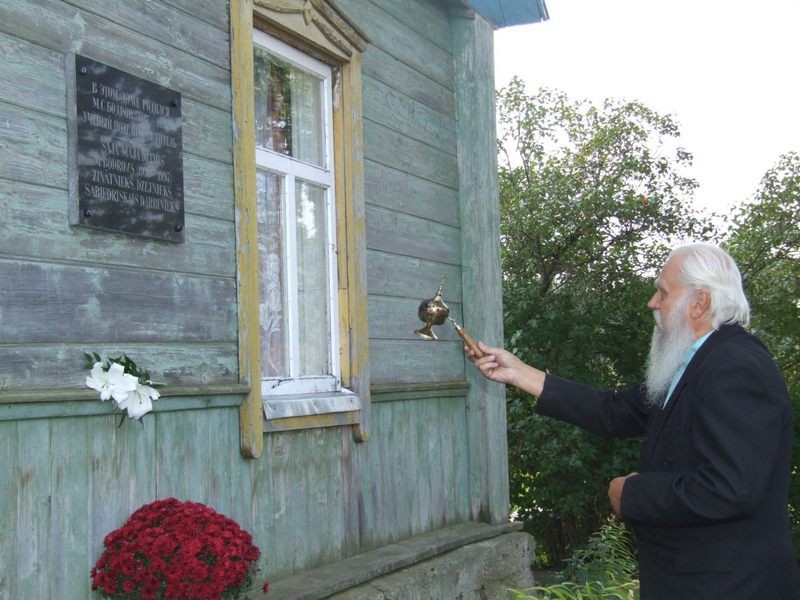
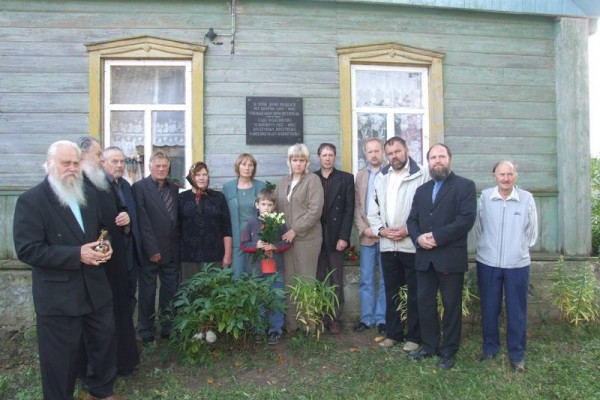
In September 2007, ten years after the death of M. Bodrov, on the initiative of a member of the Saeima Ivan Rybakov and Alexey Zhilko, a memorial plaque was installed on the house where the scholar was born. This was a tribute of remembrance from fellow countrymen, academic colleagues, students, and the Old Believer community to the “Latgalian romantic,” who sincerely dreamed of the revival of spirituality in Latgale. Some journalists dubbed him the “Don Quixote of Bodrovka”: this is how he remained in memory — a romantic, noble in his aspirations and quests, who devoted all his strength to his native land and its people. According to historian Vladimir Nikonov, chairman of the Rēzekne Old Believers’ cemetery community, many of us have “clung to the earthly and the mundane, and not everyone manages to rise above it. Bodrov did. All his life he sowed the reasonable, the good, the eternal.”
Ludmila Zhilvinsky
Sources of information:
М.С. Бодров. – Динабург, 1997, 17 августа.
http://www.grani.lv/daugavpils/39268-daugavpilchan-priglashayut-v-bodrovku.html
http://latgalesdati.du.lv/persona/2410
Related illustrations