
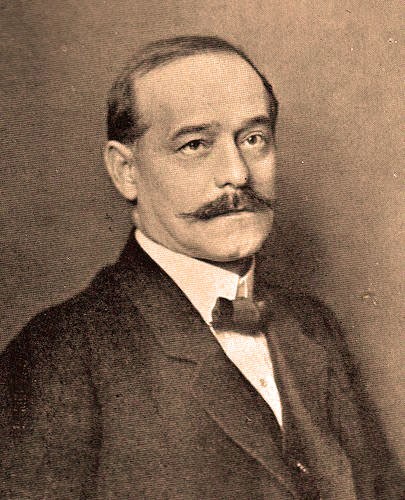
Andrey Bokhanov
Andrey Bokhanov (1st of October 1864, Kherson Governorate, Russian Empire – ?) – a notary, a businessman, a public figure and a politician.
Andrei Bokhanov was born into the family of an Orthodox priest, Andrei Bokhanov, in the village of Gnilyakovo, Kherson Governorate. He graduated from the Ananyiv Classical Gymnasium and, in 1883, enrolled in the Faculty of Law of the Imperial Novorossiysk (Odessa) University. He graduated in 1887 with the degree of Candidate of Law.
From July 1887, he served as a clerk in the office of the Odessa Commercial Court. In August 1887, he was appointed to the office of the Prosecutor of the Warsaw Judicial Chamber, and in November of the same year became a candidate for judicial office. However, in February 1888, at his own request, he resigned from the Warsaw Judicial Chamber and returned to Odessa. There, in April 1888, his wife, Sophia (née Karavia), who was of Greek origin, gave birth to their son, Andrei.
Beginning in February 1888, A. Bokhanov worked at the Odessa Judicial Chamber as an assistant to the sworn attorney Rosen. In July 1889, he successfully passed the qualifying examination for the office of notary at the Odessa District Court.
A few months later, by order of the Senior President of the St. Petersburg Judicial Chamber dated 17 November 1889, A. Bokhanov was appointed judicial notary of the Riga District and moved to Riga. He opened his notarial office on 3 December 1889. Initially, it was located at 8 Kaļķu Street (then Izvestkovaya Street). On 13 May 1890, the office moved to the corner of Kaļķu Street and 2 Basteja Boulevard, while later directories listed its address as 7 Basteja Boulevard.
In 1895, the Greek Consulate was established in Riga. By decision of the Government of the Kingdom of Greece, A. Bokhanov was appointed Vice Consul of Greece in Riga.
From the very beginning of his life in Riga, A. Bokhanov became actively involved in the city's public life. He was a prominent member of numerous Russian civic organizations. He served on the board of the Russian Club, was a member of the Executive Board of the Society of Guarantors of the Russian Theatre, and chaired its Theatre Committee (1902–1914; elected in December 1901). In 1914, the Society unanimously elected him an honorary member. At the same time, L. Ostroukhov and S. Klimov were also elected honorary members.
A. Bokhanov also served on the board of the Third Mutual Credit Society. Between 1901 and 1904, he had been a member of the Riga City Council.
During the Revolution of 1905, A. Bokhanov also became actively involved in politics. He was one of the founders and members of the Riga branch of the Constitutional Democratic Party (Kadets), established in October 1905, and served on its bureau alongside Professor Mikhail Berlov, Senior Factory Inspector A. Bykov, engineer Andrei Verkhovsky, Rizhskie Vedomosti editor Leonid Vitvitsky, gymnasium director S. Lyubomudrov, investigating magistrate Prince Serafim Mansyrev, manufacturer M. Nesterov, and senior lecturer P. Rutsky.
Altogether, A. Bokhanov served as a notary in Riga for twenty-five years. On 11 November 1914, owing to ill health, he resigned from his position at his own request. By that time, the First World War had already begun.
On the eve of his departure, representatives of the Society of Guarantors of the Russian Theatre and the Third Mutual Credit Society honoured A. Bokhanov with a farewell banquet held at Schwarz's Restaurant.
On 22 November 1914, he left Riga and returned to Odessa, where his family owned both an industrial enterprise and real estate.
The subsequent fate of the notary and entrepreneur A. Bokhanov has not yet been established. However, some information has survived regarding members of his family.
Notable Members of the Family
Wife
Sophia Karavia (1868, Odessa – ?), daughter of a first-guild merchant. In 1925, she was residing in France.
Son
Andrei Bokhanov (18 April 1888, Odessa – ?), entrepreneur and sportsman; director of the A. Bokhanov leather factory. Hereditary Honorary Citizen of Odessa. He received his education at the Lycée de Verneuil in Normandy, France, and later at the Imperial Novorossiysk (Odessa) University. After graduating, he entered the family business and became head of his father's leather factory.
Beginning in 1908, he belonged to numerous sports clubs and organizations, including the Odessa Automobile Club, the Catherine Yacht Club, the Black Sea Yacht Club, and others. He also served as Vice Chairman of the Sporting Club, and in 1912 was elected a member of the Crimean Mountain Club.
It is likely that the "A. Bokhanov Silver Shield," awarded to the runner-up of the Odessa football championship, was named in his honour.
On 18 April 1914, he married Olga (née Kavura). Their daughter Nina was born on 2 November 1915.
He is listed among the Greeks of Odessa. There is evidence that by 1925 A. Bokhanov Jr. owned ships in Turkey and applied for Latvian citizenship, although his application was rejected.
Yevgenia Bokhanova (4 July 1895 – ?), served as godmother to her niece Nina.
Interesting Facts
A. Bokhanov translated from French Edmond Demolins' book What Determines the Superiority of the Anglo-Saxon Race? (Ot chego zavisit prevoskhodstvo anglosaksonskoj rasy). The translation was published in Odessa in 1899 by the printing house of the South Russian Printing Society.
Among the pseudonyms used by the Russian Symbolist poet, translator, and essayist Konstantin Balmont was "André Bochanoff." Interestingly, a French source published in 1908–1909 also rendered the name of the elder Andrei Bokhanov—who had studied law in Odessa—as André Bochanoff.
The text was prepared by Alexandra Yakovleva, June of 2021
Sources of information:
- Russland. Aus der Ostseeprovinzen, Düna Zeitung № 277, 09.12.1889.
- Городской дневник. «Новое консульство в Риге», Рижский вестник № 109, 18.05.1895.
- Inland, Rigasche Rundschau № 233, 12.10.1895.
- Vietējās ziņas, Dienas Lapa (Rīga, Petrograda), Nr. 276, 04.12.1901.
- Lokales. Eine russische konstitutionelle Partei, Düna Zeitung № 240, 01.11.1905.
- Юбилейное историческое и художественное издание в память 300-летия царствования державного Дома Романовых. Москва, 1913.
- Русский театр в Риге (1883-1912). Рига, 1913. http://www.russkije.lv/ru/
journalism/read/theatre-in- riga-1812/ - Vietējās ziņas. «Rigas notārs Bohanovs», Dzimtenes Vēstnesis № 260, 11.11.1914.
- Городской дневник, «Быв. рижский нотариус А. А. Боханов», Рижский вестник № 271. 24.11.1914.
- Lokales. Der frühere hiesige Notarius A. A. Bachanow, Rigasche Rundschau № 272, 24.11.1914.
- Л.Г. Белоусова, А.В. Мартыненко, А.М. Паниван, М.Г. Батурина, А.Е. Бух “Труды государственного архива Одесской области”, Том XXVII, Греки Одессы, Именной указатель по метрическим книгам Одесской Греческой Свято–Троицкой церкви, часть VI1907 – 1920. – Одесса, 2009.
- Latvijas notariāts. 1889-1945. Biogrāfiskā vārdnīca. – Sast. Ēriks Jēkabsons, Valters Ščerbinskis. – Rīga, 2013.